Showing posts with label RDA. Show all posts

March 22, 2013

RDA and NHU-PAC

The upcoming OCLC RDA policy implementation (March 31, 2013) should not have any effect on NHU-PAC users. We reviewed the OCLC plan (because all NHU-PAC records come from the OCLC WorldCat) when it was announced back in January and determined that NHU-PAC is set. The parts of the OCLC policy that relate to NHU-PAC boil down to this:

  • OCLC WorldCat will continue to include both AACR2 and RDA records. So will NHU-PAC, as it has for several years now (see New RDA Field post).
  • MARC fields that are new to the RDA format will need to be added to display and search mappings in local systems (including NHU-PAC) if the library feels the information in those fields is important to their users. We made the needed changes to NHU-PAC search and display for the 264 tag. We determined that no other tags needed to be accommodated in NHU-PAC displays. If you wish to see the full record with all the tags use the 'marc display' toggle on the bottom of the left hand panel of a record display.
  • A new record MAY not be added to WorldCat if there is an existing record in the library's language of cataloging for the item in hand regardless of the cataloging standard (RDA or AACR2) of the record. This fact requires that NHU-PAC continue to include both formats of record.
  • New records being added to WorldCat may continue to be AACR2, or they may be RDA. The NHAIS Services Original Cataloging Program will continue to create records that comply with AACR2.  We will not be transitioning to RDA in the foreseeable future.
When the Library of Congress implements RDA, that change will probably result in more OCLC records being RDA instead of AACR2, but will otherwise have no impact on NHU-PAC users.

NHAIS Libraries that download records for their local systems from NHU-PAC will have (and have had since 2010)  both AACR2 records and RDA records in their local systems. They should check that the records both search and display the way they want them to. If they don't, you will need to work with your local system vendor to make any needed changes. If you get records from sources other than NHU-PAC, you will need to find out what those sources are doing regarding the RDA transition if you want to know what you are adding to your local catalog.

Basically three options are available to a library regarding RDA:
  1. Maintain a hybrid catalog with both AACR2 and RDA records in it.
    I think this is the best plan and it is what NHSL (both Technical Services and NHAIS) is doing.
  2. Keep only AACR2 records in your catalog -- this will drastically limit your ability to use cataloging records from sources beyond your own library as more record sources move to RDA without significant editing of each record.
  3. Transition your catalog entirely to RDA -- this will require you to re-catalog every item in your catalog to the new standard as well as revising any shared records for new materials that were cataloged by other libraries to the AACR2 standard.


December 31, 2012

264 Tag

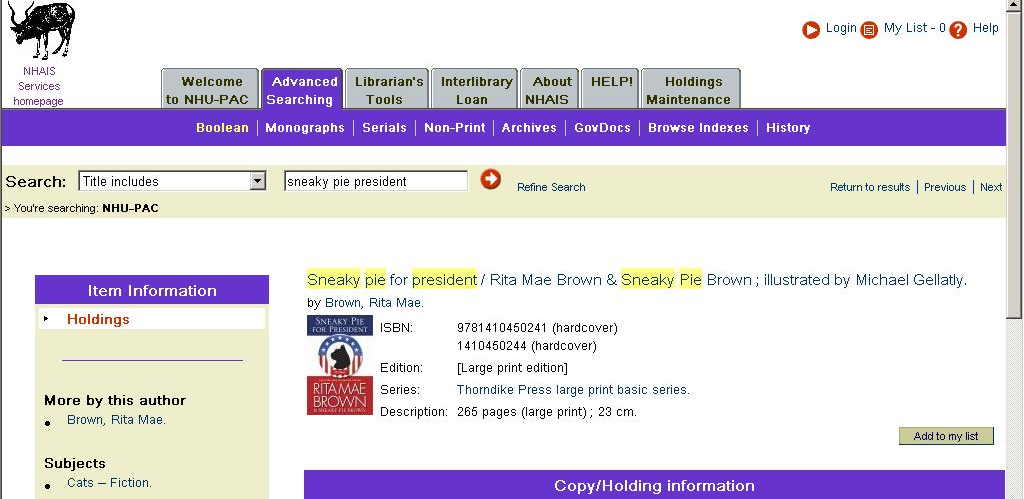
As David explained in an October post about RDA records, the 264 tag is being used (in some records) for publishing information instead of the 260 tag. As of this morning, when the new index was loaded, the 264 tag information (for both publisher name and place of publication) is included in keyword searches for "publication info includes." Additionally this information now displays in search results.

This nhu-pac search will show you an example of this tag in use:
Title: sneaky pie
AND Publisher: Thorndike

October 3, 2012

New RDA field

It’s been transparent to many users but bibliographic records cataloged under the new RDA rules have been making their way into the NHU-PAC since 2010. At first it was just a trickle; more recently we’re seeing a dozen or more RDA records added to the database each week. That’s still a small percentage of the 1200 or so records added to the NHU-PAC in a typical week. Now we’re starting to see some RDA records with publication information in a new field which our system isn’t configured to display. Here’s an example:

What’s missing from the display is “Waterville, Maine : Thorndike Press, 2012,” which should appear above the ISBNs. In this and a handful (so far) of other RDA records, the publication information is entered in field 264 rather than field 260.  The Library of Congress MARC Standards site tells us “Information in field 264 is similar to information in field 260 (Publication, Distribution, etc. (Imprint)). Field 264 is useful for cases where the content standard or institutional policies make a distinction between functions.”

In addition to the display issue is the consideration that field 264 is not currently indexed for “Publication info includes” keyword searches.  As we expect the future to bring more records with publication information in this new field, NHAIS Services expects to modify the NHU-PAC for correct display and searchability of this field by the end of the year.

May 16, 2008

Latest on the RDA debate

Leaders of the Library of Congress , the National Library of Medicine, and the National Agricultural Library met on March 10, 2008 to discuss the recommendation from On the Record: the Report of the Library of Congress Working Group on the Future of Bibliographic Control to "suspend work on RDA." Deanna Marcum has issued a letter regarding this meeting along with the statement from the group.

January 17, 2007

The future of cataloging rules

Linda Tiernan Kepner of the Peterboro Town Library sent me an email this morning about an article that I think may be of interest to others following the development of RDA. The article comes from D-Lib Magazine which is an electronic journal focused on digital library research and development.
This opinion piece basically explains all the ways that the authors think that the Joint Steering Committee is heading in the wrong direction with their redesign of the cataloging rules. The author's make some valid points, and provide an excellent overview of the development of the cataloging rules along with citations (and links) to the documents and articles they are discussing.

Personally, I think the authors of this article are too willing to throw out the baby with the bathwater in their desire to look forward into a digital future instead of building on the past.

"While the goals of the progressive librarians building new interconnected
library services are admirable, they need to be achieved in short order if
libraries are to retain their users' loyalty. It does not seem to matter to most
users that libraries currently are the only conduits for a wealth of published
literature that is not available for open access on the public Internet. Users
will engage with services that provide materials quickly and with the least
effort. The "invisible library," like the dark web, is of no interest to those
who do not know that it exists. "

The premise that an electronic catalog should be driven by rules designed to create handwritten 3x5 cards has always struck me as idiotic, but it seems equally short-sighted to abandon the wealth of materials already held in (and cataloged by) libraries in favor of the born-digital documents proliferating on the web. It seems to me that a compromise between the two is the best approach to providing accurate, useful information to people when they need it. (Isn't that what libraries are here for?)